
Every time you connect an MCP server in Claude Code, you’re paying a tax you can’t see. Could be worth it or the utility of a little server running away, but how do you know if it is?
I discovered this while investigating why my Claude Code sessions kept running out of context faster than expected. The culprit wasn’t the tasks themselves but rather the architecture I’d chosen to execute them.
After researching Anthropic’s documentation, analyzing GitHub issues, and testing real-world scenarios, I found a consistent pattern: MCP servers consume 10-100x more tokens than Skills with scripts for equivalent operations.
This article breaks down the root cause analysis, presents the data, and offers a decision framework for when to use each approach.
The Root Cause: When Things Load Into Context
The fundamental difference between Skills and MCP isn’t what they can do, it’s when their definitions consume your context window.
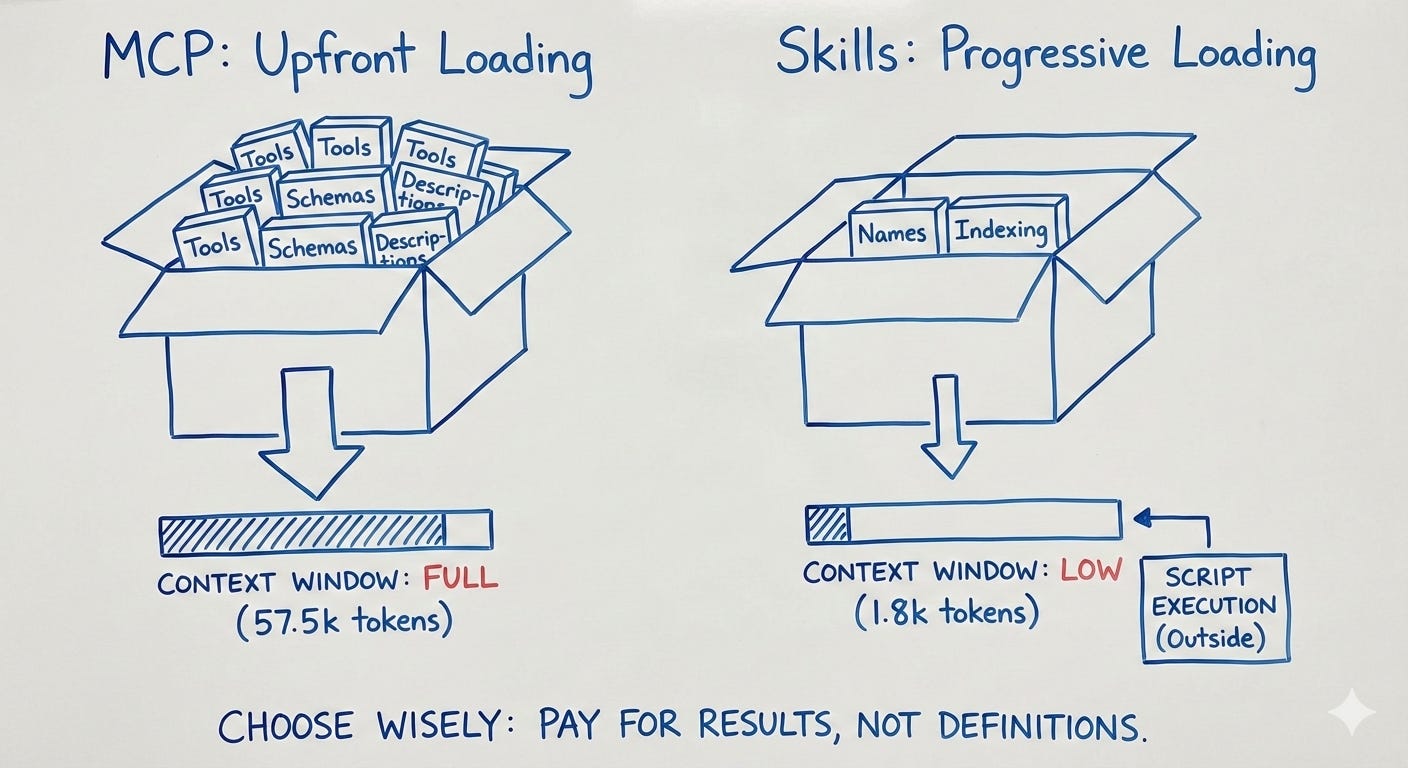
MCP: Upfront Loading
When you connect an MCP server, Claude Code loads every tool definition into context immediately. Every tool name, every parameter schema, every description, regardless of whether you’ll use them.
Startup Flow (MCP):
    All servers connected
    → All tool definitions loaded into context
    → 5,000-80,000+ tokens consumed before first query
Connect 5 servers exposing 60 tools? You’ve burned approximately 55,000 tokens before Claude does anything.
Skills: Progressive Disclosure
Skills use a three-stage loading architecture that minimizes context consumption:
Startup Flow (Skills):
    Names + descriptions indexed (~30-50 tokens per skill)
    → User request matches skill
    → Full SKILL.md loads (~500-2,000 tokens)
    → Script executes OUTSIDE context
    → Only output returns to context (~100 tokens)
From Anthropic’s documentation:
“Scripts in your Skill directory can be executed without loading their contents into context. Claude runs the script and only the output consumes tokens. This is useful for complex validation logic that would be verbose to describe in prose, and data processing that’s more reliable as tested code than generated code.”
The key insight: script code never touches the context window. You pay only for the result.
The Data: 32x Token Difference
Here’s a direct comparison on an identical task:
Skills Approach (5 skills):
Stage Token Cost Startup ~200 tokens (names + descriptions) Single skill invocation ~1,500 tokens Script execution ~100 tokens (output only) Total ~1,800 tokens
MCP Approach (5 servers, ~60 tools):
Stage Token Cost Startup ~55,000 tokens (all definitions) Tool selection ~500 tokens Result handling ~2,000 tokens Total ~57,500 tokens
The difference: 32x more tokens for MCP on this configuration.
Simon Willison’s analysis captured why this matters:
“Context consumption is the critical bottleneck for complex Claude Code workflows. Skills that execute code outside of context are, for many use-cases, a bigger deal than MCP.”
Timeout and Reliability: A Deeper Problem
Token efficiency isn’t the only concern. MCP servers introduce timeout fragility that Skills avoid entirely.
MCP Timeout Issues (Documented)
From GitHub issues on anthropics/claude-code:
“Claude Code is not respecting MCP timeout settings configured in settings.json, causing HTTP MCP servers to appear ‘offline’ due to premature SSE stream disconnections.”
“MCP tool calls over 60s in duration fail due to -32001 timeout in the mcp typescript-sdk. Because there is no good way to predict valid timeouts for many classes of long duration tool calls (think sub-agents) it would be best to utilize the MCP progress reporting mechanism.”
“The SSE control channel should stay open indefinitely so the CLI can send tasks even after long idle periods... CLI logs error and the command fails. Work-around: Restarting claude --mcp-debug restores functionality.”
The Reliability Matrix
Factor Skills + Scripts MCP Servers Network dependency Only for API calls in script Always (server connection) Timeout configuration Standard HTTP (you control it) Complex, often ignored Connection state Stateless Stateful (SSE) Idle handling N/A Disconnects after 5-10 min Recovery mechanism Retry script Restart Claude session Long-running tasks Script manages internally 60s hard limit (common) Testability Full (run script directly) Limited (requires MCP client)
Skills inherit whatever timeout handling you build into your scripts. MCP servers are subject to the TypeScript SDK’s 60-second hard limit and SSE connection management issues.
Consistency and Determinism
From Anthropic’s engineering documentation:
“And because code is deterministic, this workflow is consistent and repeatable.”
Skills produce deterministic results. The same script with the same inputs produces the same output. You can test scripts outside Claude, version control them, and validate their behavior independently.
MCP results depend on multiple variables:
Claude’s interpretation of tool schemas
Server implementation quality
Network conditions
Server-side state
From enterprise implementation analysis:
“MCP servers change their APIs. When a server updates, your agent’s behavior may change without warning. Skills with scripts isolate you from this—your script calls a versioned API endpoint you control.”
When MCP Still Wins
This isn’t an argument against MCP. It’s an argument for choosing the right tool for the context.
MCP excels at:
Real-time data access: Live databases, streaming APIs, data that changes between calls
Dynamic discovery: Exploring unfamiliar schemas before you know what patterns you need
Enterprise auth standardization: OAuth flows, SSO integration (still evolving)
Ecosystem leverage: 800+ community servers provide immediate capabilities
The New Stack’s production guidance:
“MCP works for anything that looks up information on a network you trust... Where it doesn’t fit as well is anything that modifies or creates files.”
The Decision Framework
After analyzing the tradeoffs, this flowchart captures the decision logic:
Is this operation repeatable?
        /            \
      YES             NO
      /                \
Skills preferred    Reliability Critical?
                     /            \
                   YES             NO
                   /                \
           Skills preferred   Need Real-time Data?
                                /            \
                              YES             NO
                              /                \
                       MCP required      Skills preferred
Quick heuristics:
If the operation will execute more than twice → Skill
If you need live, changing data → MCP
If timeout reliability matters → Skill
If you’re exploring unfamiliar territory → MCP first, then codify
The Hybrid Pattern: Best of Both Worlds
The most efficient architecture combines both approaches strategically.
Pattern: MCP for Discovery, Skills for Execution
From CData’s research:
“Once the LLM explored the dataset and constructed the appropriate request, we added that request to a Claude Skill that sends that request directly through Connect AI’s REST API. This led to a significant reduction in token usage, but this was only possible after the LLM explored the data using Connect AI’s MCP server.”
Workflow:
Connect MCP server for initial exploration
Claude discovers data schema, available operations
Identify repeatable patterns
Codify into Skill with direct API scripts
Disconnect MCP server
Use Skill for ongoing operations
One team reported 99% token reduction using this pattern (from Speakeasy’s engineering analysis).
Pattern: Skills That Optimize MCP Access
When you must use MCP, wrap it in a Skill that provides context:
---
name: salesforce-query-patterns
description: Patterns for Salesforce data access. Use before querying CRM.
skills: salesforce-mcp
---

# Salesforce Query Patterns

## Before querying:
1. Identify object type (Account, Contact, Opportunity)
2. Determine required fields (minimize selection)
3. Apply filters to limit results

## Efficient patterns:
- Use SOQL WHERE clauses
- Limit to 100 records unless pagination needed
- Select only fields you'll use
This “Skill-gated MCP” approach reduces unnecessary tool calls by giving Claude context about efficient usage patterns.
The Architectural Principle
The clearest framing I’ve found:
“Skills tell Claude how to use tools; MCP provides the tools.”
Separate these concerns:
MCP: Dynamic capability discovery, real-time data access
Skills: Deterministic execution, token-efficient workflows
Scripts: Reliable, testable operations outside context
When the same operation will be performed repeatedly, codifying it as a Skill with a script will almost always outperform keeping an MCP server connected.
Implementation Resources
I’ve published the full research document with:
Complete token budget comparisons
Timeout configuration reference
Decision checklists
Source citations in MLA format
Sources
Anthropic. “Agent Skills - Claude Code Docs.” Claude Code Documentation, 2025. https://code.claude.com/docs/en/skills
Anthropic. “Agent Skills Overview.” Claude Developer Platform, 2025. https://platform.claude.com/docs/en/agents-and-tools/agent-skills/overview
Anthropic. “Code Execution with MCP: Building More Efficient AI Agents.” Anthropic Engineering Blog, 2025. https://www.anthropic.com/engineering/code-execution-with-mcp
Anthropic. “Connect Claude Code to Tools via MCP.” Claude Docs, 2025. https://docs.claude.com/en/docs/claude-code/mcp
Anthropic. “MCP vs Claude’s Built-in Tools.” Claude Docs, 2025. https://docs.claude.com/en/docs/claude-code/mcp#mcp-vs-claudes-built-in-tools
CData. “Integrating Claude 3.7 Sonnet into a Streamlined Workflow for Enterprise Data.” CData Blog, 2025. https://www.cdata.com/blog/integrating-claude-37-sonnet
GitHub. “Claude Code Issue #442: MCP Timeout Configuration.” anthropics/claude-code, 2025. https://github.com/anthropics/claude-code/issues/442
GitHub. “MCP Issue #1066: Tool Call Timeout.” modelcontextprotocol/typescript-sdk, 2025. https://github.com/modelcontextprotocol/typescript-sdk/issues/1066
Speakeasy. “Reducing MCP Token Usage by 100x — You Don’t Need Code Mode.” Speakeasy Blog, 18 Nov. 2025. https://www.speakeasy.com/blog/how-we-reduced-token-usage-by-100x-dynamic-toolsets-v2
Spence, Scott. “Optimising MCP Server Context Usage in Claude Code.” Scott Spence, 30 Sept. 2025. https://scottspence.com/posts/optimising-mcp-server-context-usage-in-claude-code
The New Stack. “15 Best Practices for Building MCP Servers in Production.” The New Stack, 15 Sept. 2025. https://thenewstack.io/15-best-practices-for-building-mcp-servers-in-production/
ThinhDA. “Building Production-Ready MCP Servers: Taking FastMCP to Enterprise Level.” ThinhDA, 30 Apr. 2025. https://thinhdanggroup.github.io/mcp-production-ready/
Willison, Simon. “Claude Skills Are Awesome, Maybe a Bigger Deal than MCP.” simonwillison.net, 16 Oct. 2025. https://simonwillison.net/2025/Oct/16/claude-skills/
Xenoss. “MCP in Enterprise: Real-World Applications and Challenges.” Xenoss Blog, 15 Sept. 2025. https://xenoss.io/blog/mcp-model-context-protocol-enterprise-use-cases-implementation-challenges
Update! I drafted this post last week. Sat on it. Then Anthropic updated MCPs with a tool search to decrease MCP Bloat. The main principle above skill applies - Skills are on demand and MCPs need to be loaded. https://x.com/i/status/2011523109871108570